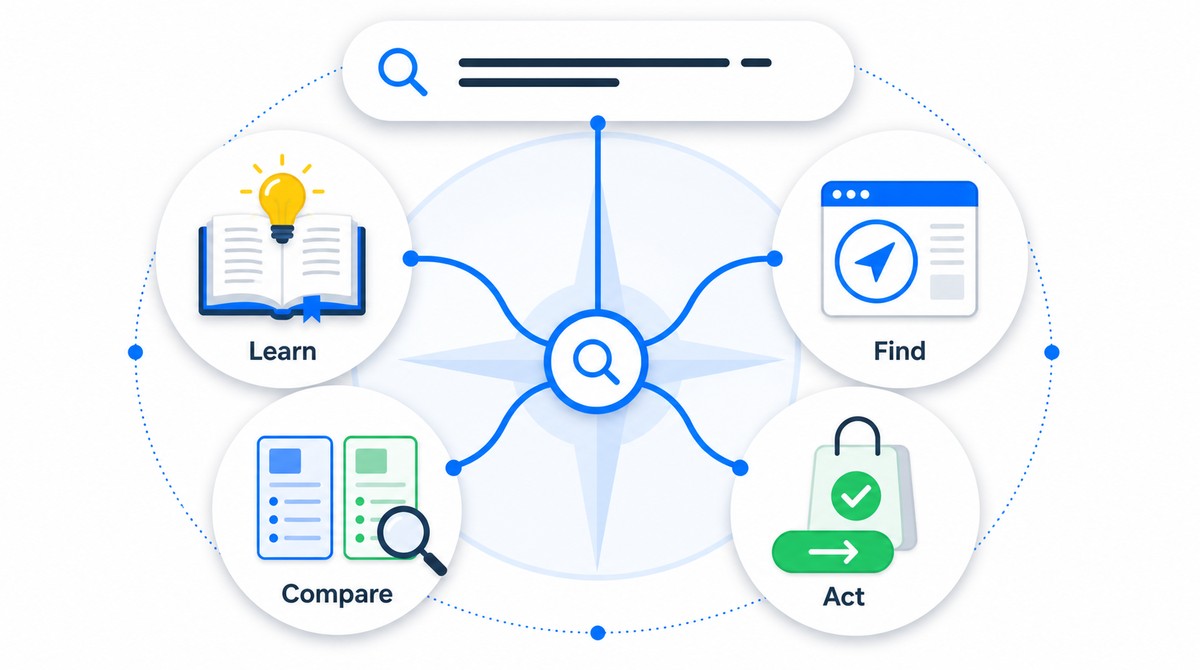
Search intent is what a person is trying to accomplish when they search. A query may be a request for an explanation, a route to a known website, help comparing choices, an action such as buying or booking, or a mixture of these needs. Good SEO begins by understanding that outcome before choosing keywords, headings or word count.
This sounds obvious, but it explains many pages that are technically optimized and still disappoint. A detailed article is a poor answer when someone needs a calculator. A product page is frustrating when the searcher wants an impartial comparison. A long introduction gets in the way when one direct fact would complete the task.
Search Intent Is the Task, Not Just the Keyword
Keywords show the language a searcher used. Intent describes the job behind that language. Consider the query technical seo audit. One person may want to understand what an audit includes. Another may want a downloadable checklist. A third may be comparing consultants, and a fourth is ready to request a service.
The words alone do not always reveal which need dominates. Context can change the interpretation, including location, device, language, current events and the searcher's previous journey. This is one reason the results for a short, broad query often include several page types.
Google's documentation explains that results are selected for each query and can depend on factors such as the query, location, language and device. The guide to how Google Search works places that relevance decision within the larger crawling, indexing and serving process. Your page first has to be discoverable and indexable, but it also needs to be a useful result for the particular need.
The Four Practical Types of Search Intent
SEO teams commonly sort queries into four categories. This model is useful for planning, but real searches do not always stay inside one box.
1. Informational
The searcher wants to learn, understand or solve something.
what is technical seowhy is my page not indexedhow to add canonical tag
Likely pages: guides, tutorials, definitions, videos, tools and documentation.
2. Navigational
The searcher wants a specific website, brand or page.
search console loginivig seo guidesgoogle pagespeed insights
Likely pages: official homepages, login pages, branded sections and known tools.
3. Commercial investigation
The searcher is evaluating options before deciding.
best seo audit toolsscreaming frog vs sitebulbtechnical seo consultant cost
Likely pages: comparisons, reviews, alternatives, case studies and pricing explainers.
4. Transactional
The searcher is ready to complete an action.
hire technical seo consultantbuy screaming frog licencebook seo audit
Likely pages: service pages, product pages, booking flows, signup pages and downloads.
Commercial and transactional intent are easy to confuse. A person comparing three tools is still reducing uncertainty. A person searching for a specific plan with words such as buy, book or download is closer to acting. The distinction helps you decide whether the page should lead with evidence and comparison or with a direct conversion path.
Google Uses Different Language for User Needs
The four categories above are an industry planning framework. They are not Google's official list of ranking-system labels. Google's public Search Quality Rater Guidelines train evaluators to think about needs such as Know, Know Simple, Do, Website and Visit-in-Person.
- Know covers learning or exploring a topic.
- Know Simple covers a specific answer that can usually be expressed briefly.
- Do covers accomplishing a goal or activity, including buying, downloading or interacting.
- Website covers reaching a particular website or page.
- Visit-in-Person covers finding a nearby business, service or place.
The guidelines also tell evaluators to consider reasonable interpretations, different formats and multiple possible intents. That is the more important lesson than memorizing either set of labels.
Quality raters do not control rankings and their ratings are not used directly to rank a page. Google explains that rater feedback is used to evaluate whether search systems are producing useful results. Use the guidelines to understand how nuanced user needs can be, not as a formula for reverse-engineering an algorithm.
One Query Can Have Mixed or Changing Intent
A search for a brand such as walmart might mean visit the website, shop online, find a nearby store, check opening hours or read recent news. A search for broadway tickets can involve both researching prices and purchasing. Google's evaluator guidance uses examples like these to show why a single query can support more than one helpful result.
Intent can also change during a journey:
Learn
What causes a slow website?
Compare
Which audit or specialist fits?
Act
Request an audit or fix.
You do not need one page to own the entire journey. A guide can answer the early question, link to a case study for evidence and lead to a service page when the reader is ready. A thoughtful internal-link structure connects those changing needs without turning every article into a sales page.
Freshness can alter intent too. core web vitals may call for an evergreen explanation, while core web vitals update signals a current change. Local modifiers, dates, model numbers, near me, review, vs, price and login all narrow the task.
How to Identify Search Intent Step by Step
- Define the likely searcher. A beginner and a specialist can use different language for the same subject. Google's SEO Starter Guide notes that experienced users may search with terms a newcomer would not know.
- Read the query literally. Note the subject, verb, brand, place, date and qualifiers. Do not assign a type before understanding the whole phrase.
- Mark intent modifiers. Words such as what, how, login, best, review, vs, price, buy and near me are useful clues, not absolute rules.
- Inspect the current search results. Look at recurring page types, content formats, result features, dates and angles. Search from the relevant country and device when those factors matter.
- Name the primary task in one sentence. For example: "A site owner wants to understand why a known URL is missing from Google and choose the next diagnostic check."
- List the evidence needed to finish it. A definition may need examples. A comparison needs criteria and tradeoffs. A transactional page needs scope, trust and a clear action.
- Identify reasonable secondary intent. Add a compact answer or next step when it belongs naturally, but do not dilute the primary task.
- Check your own query data. When data is available, use Search Console to see the actual queries and pages receiving impressions. The Search Console setup guide explains how to connect and verify a property.
Match the Intent to the Page Type and Format
After you define the task, choose the smallest page that can satisfy it well. Length should follow the job. Google explicitly says it has no preferred word count, so expanding a simple answer into two thousand words does not make it more helpful.
Match the experience
- Definition query: concise answer plus essential context
- How-to query: ordered steps, prerequisites and checks
- Comparison query: shared criteria, differences and tradeoffs
- Product query: specifications, availability, price and purchase path
- Local query: location, hours, service area and contact route
- Diagnostic query: decision tree, examples and next actions
Avoid mismatches
- Long essay before a simple answer
- Sales page pretending to be an impartial review
- Generic blog post for a query needing a tool
- Category page with no way to compare options
- Outdated article for a freshness-sensitive query
- One page competing for unrelated tasks
Format is part of the answer. A recipe needs ingredients and steps. A calculation may need an interactive input. A visual repair needs annotated images or video. A software setup guide needs exact screens and validation checks. Different formats can satisfy different people even when the broad intent is shared.
Your title, H1, introduction and snippet should set the same expectation the page fulfills. The on-page SEO guide explains how to align those elements without repeating a keyword mechanically.
Decide Whether to Map, Split or Combine Pages
A keyword list often contains many phrases that describe the same task. The beginner keyword research guide explains how to discover, evaluate and group those phrases before mapping them. Creating a separate page for every variation produces thin overlap. At the other extreme, forcing every related phrase into one giant page makes its purpose unclear.
Use intent as the boundary:
- Combine phrases when the same audience needs the same answer, page type and next step.
what is search intentandsearch intent meaningcan belong on one guide. - Split pages when the outcome or ideal experience changes.
what is an seo audit,seo audit checklistandhire seo auditorcan justify an explainer, a checklist and a service page. - Use a hub when one broad topic contains several distinct tasks that deserve depth and a navigable relationship.
- Consolidate overlap when two pages compete for the same audience and outcome without offering meaningfully different value.
This is also how intent helps diagnose keyword cannibalization. Two ranking URLs are not automatically a problem. The real question is whether they serve distinct useful needs or create confused duplication. If pages should be one resource, combine the content, redirect the retired URL and keep canonical signals, links and sitemaps aligned.
Create a simple content map with one row per intended page: audience, primary task, page type, target query cluster, proof required, conversion or next step, and related pages. That is more useful than assigning one exact keyword to every URL.
Measure Whether the Intent Match Works
No single metric proves that a page satisfied intent. Use several signals and interpret them in the context of the page:
- Search Console queries and pages: check whether impressions come from the tasks you intended to serve, and whether a different URL repeatedly appears for them.
- Click-through rate: compare it with query position and result type. A mismatch between the snippet's promise and the page can reduce useful clicks, but SERP features also affect CTR.
- Engagement and completion: measure the action appropriate to the page, such as using a tool, expanding steps, reaching a related guide, submitting a form or completing a purchase.
- Follow-up searches and support questions: repeated missing questions can show where the answer or next step is incomplete.
- Conversion quality: for commercial pages, assess whether leads or sales match the offer, not just whether a button received clicks.
A high bounce rate is not automatically failure. Someone can read a direct answer and leave satisfied. A long session is not automatically success either; the visitor may be lost. Define the successful outcome first, then choose the metric.
When a page underperforms, recheck the query set, current results, page type and opening answer before adding more words. Search results and user expectations can change, especially for products, regulations, software and current events.
Search-Intent Mistakes That Waste Good Content
- Classifying intent from one modifier. The word best suggests comparison, but the complete query and results may reveal a different need.
- Treating the four types as Google's ranking labels. They are a practical SEO model, not a published algorithm taxonomy.
- Choosing a keyword before a purpose. The writer is told what phrase to repeat but not whom the page should help or what they should accomplish.
- Copying the current SERP. Matching a page type is useful; reproducing the same outline without original value is not.
- Ignoring mixed intent. A broad query may require several result types, and no single page can honestly satisfy everyone.
- Writing one format for every task. Not every query needs a blog post. Some need a category, comparison, calculator, video, product or local page.
- Forcing sales intent into an informational guide. An aggressive conversion path can undermine the answer a reader came for.
- Building separate pages for synonyms. Small wording differences do not justify several near-duplicate pages when the task is the same.
- Using word count as a quality target. Completeness is about finishing the task, not reaching a number.
- Never revisiting the assumption. Query language, result formats and customer needs change. The map needs periodic validation.
Search-Intent Checklist for a New Page
Answer these before publishing
- I can describe the likely audience and primary task in one sentence
- I reviewed the complete query, its modifiers and reasonable secondary intents
- I inspected current results for recurring page types, formats and freshness
- The chosen page type can genuinely complete the task
- The answer appears as early as its complexity allows
- The page adds original examples, proof, experience or a more useful process
- The title, H1, introduction and next action set one consistent expectation
- Related pages serve distinct needs and connect through useful internal links
- I know which real behavior or business outcome will indicate success
Is Your Content Solving the Right Search Problem?
A technical audit can reveal pages that are crawlable and indexable but mapped to the wrong task, format or destination. I review query targeting alongside canonicals, internal links and site architecture, then prioritize the changes most likely to improve qualified visibility.
Request a free reviewSearch Intent: FAQ

I'm a developer who moved into technical SEO. I map search intent alongside the actual crawl, indexation and site architecture because a strong page needs both a clear purpose and a reliable path into search. Request a free website review and I'll review the highest-impact gaps personally.